

Reviving the "Gold" of Tombo Coffee: Boosting the Economy and Preserving the Environment
Bhimasena Power, Batang Power
Plant – Long before coffee became part of today's lifestyle trend, Tombo
Village, Bandar District, Batang Regency, was already familiar with this
commodity.
Since
the Dutch colonial era, Tombo has been known for its rich coffee heritage,
which was once marketed internationally. Coffee became one of the backbones of
local agriculture and a core part of the village's identity passed down from
generation to generation.
However,
the journey of Tombo coffee did not always remain in its golden age. Increasingly
fierce market competition and various challenges in commodity management caused
coffee to be gradually displaced by other crops, including rubber and tea. Over
time, the glory of Tombo coffee faded compared to its past heights.
Today,
the spirit to revive the potential of Tombo's "gold" is beginning to
grow. The community, including the village's youth, has started viewing coffee
not just as a legacy of the past, but as an economic opportunity with a
promising future. At the same time, developing coffee is seen as something that
can go hand in hand with environmental conservation, particularly in the
Watershed Area (Daerah Aliran Sungai / DAS).
This
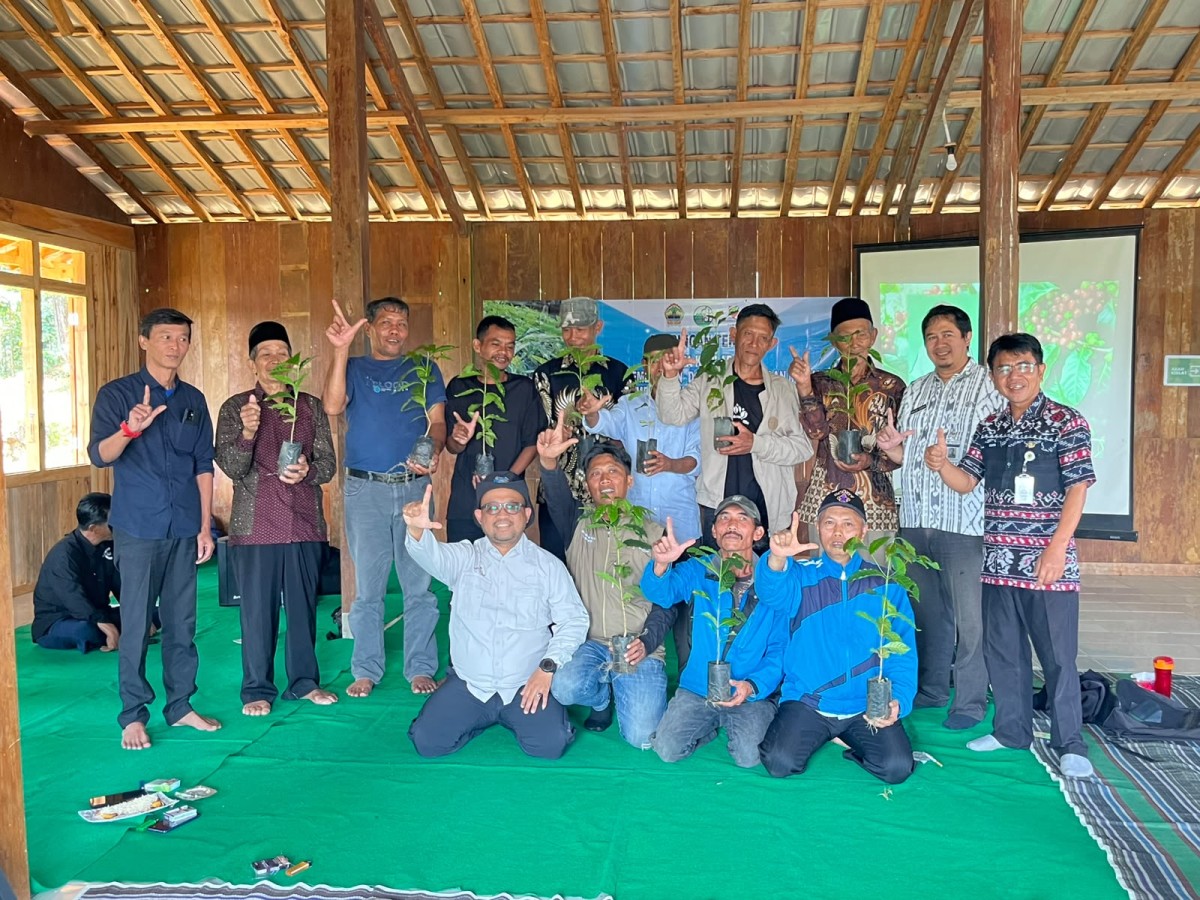
spirit was brought to life through a Technical Guidance (Bimbingan Teknis / Bimtek)
workshop on Arabica Coffee Cultivation for Tombo Village farmers at Pondok
Sidawung on Tuesday (August 11, 2026). This activity was part of the
Sustainable Watershed Program (DAS Lestari), which promotes community economic
development alongside sustainable environmental management.
Farmers
received practical knowledge on Arabica coffee cultivation, ranging from
planting techniques to pest and disease management. Burohim and Anang from the
Surjo Coffee Farmers group attended as speakers to share their experience and
practical knowledge that can be applied directly in the fields.
Enthusiasm
was high throughout the event. Participants asked various questions,
particularly regarding plant pests and diseases—one of the main challenges in
maintaining coffee growth and productivity. For the farmers, this knowledge was
not just training material; what they learned will be brought back to their
farms to help care for their crops properly.
One
of the participants, Tarmujo, a coffee farmer in Tombo, said the training
provided a clearer understanding of the stages of coffee cultivation.
“For today’s training, everything from planting to the knowledge
and handling of pests and diseases was very clear. Moving forward, I will apply
and practice this in managing my coffee plants,” he expressed.
The
Head of Tombo Village, Mustajab, sees the farmers' enthusiasm as crucial
momentum to re-strengthen coffee development in his village.
“Alhamdulillah, the farmers were very enthusiastic about
participating in this activity. Many questions were raised, and hopefully, the
knowledge gained will support the successful development of Arabica coffee in
Tombo Village. We hope that from this initial stage through implementation,
everything goes well and impacts the community's economic growth,” he stated.
This
training on cultivation was followed up with seedling support. A total of 5,400
Arabica coffee seedlings were prepared to support planting on farmers' land.
Based
on a survey conducted by Region IV Forestry Branch Office under the Central
Java Environment and Forestry Service (CDK IV) across 27 land parcels, the
seedlings are scheduled to be distributed to 13 farmers for planting ahead of
the rainy season.
Interestingly,
this development is not taking place by clearing new forest areas. All planting
locations are situated on farmers' private land and outside forest zones.
Consequently, coffee expansion is achieved without deforestation or forest
encroachment.
Instead,
the coffee plants belong to the MPTS (Multi-Purpose Tree Species)
category—crops that offer not only economic benefits through their yield but
also ecological functions. These plants are expected to help maintain soil
health, reduce erosion risks, and support the surrounding environmental
ecosystem.
Through
this approach, coffee development in Tombo aims to bridge two equally vital
interests for the community: increasing the economic value of the land while
preserving its ecological function.
This
process is being carried out collaboratively, involving the Tombo Village
Government, the Forest Village Community Institution (LMDH), CDK Region IV, and
PT Bhimasena Power Indonesia (BPI).
For
BPI, the success of a community empowerment program requires more than just
providing seedlings; farmers' knowledge and capacity must be strengthened so
the community can manage this potential independently and sustainably.
General
Manager of Stakeholder Relations at PT Bhimasena Power Indonesia, Aryamir H.
Sulasmoro, highlighted that capacity building is an essential component of
program sustainability.
“Support for the community isn't just about supplying seedlings,
but also about how the farmers' knowledge and skills can continue to grow.
Through this activity, we hope farmers have sufficient knowledge to cultivate
Arabica coffee while managing their land sustainably,” he explained.
As
a follow-up to the workshop, farmers will also receive mentoring to ensure that
seedling planting and maintenance follow the techniques and knowledge provided
during training.
As
a result, the development process does not stop when the training session ends.
Knowledge will be applied in the fields, seedlings will be planted and
nurtured, and ongoing mentoring will help farmers overcome challenges as the
crops grow.
The
journey to restore the glory of Tombo coffee will certainly not happen
overnight. It takes time for seedlings to grow, for farmers to tend to them,
and for the harvest to deliver economic benefits.
Yet,
this small step brings a grand hope: that the coffee that was once Tombo’s
strength can reclaim its vital role in the lives of the community. Not by
repeating the past, but by building a more sustainable future.
Because
for the people of Tombo, the "gold" of coffee is not just about the
harvested fruit. It is about the economic value that grows in the hands of
farmers, the knowledge passed on to the next generation, and the land that
remains preserved for future life. (**)