

UNDIP and Bhimasena Power Launch AFA and APR Research Downstreaming Products to Support Marine Ecosystem Restoration in Batang
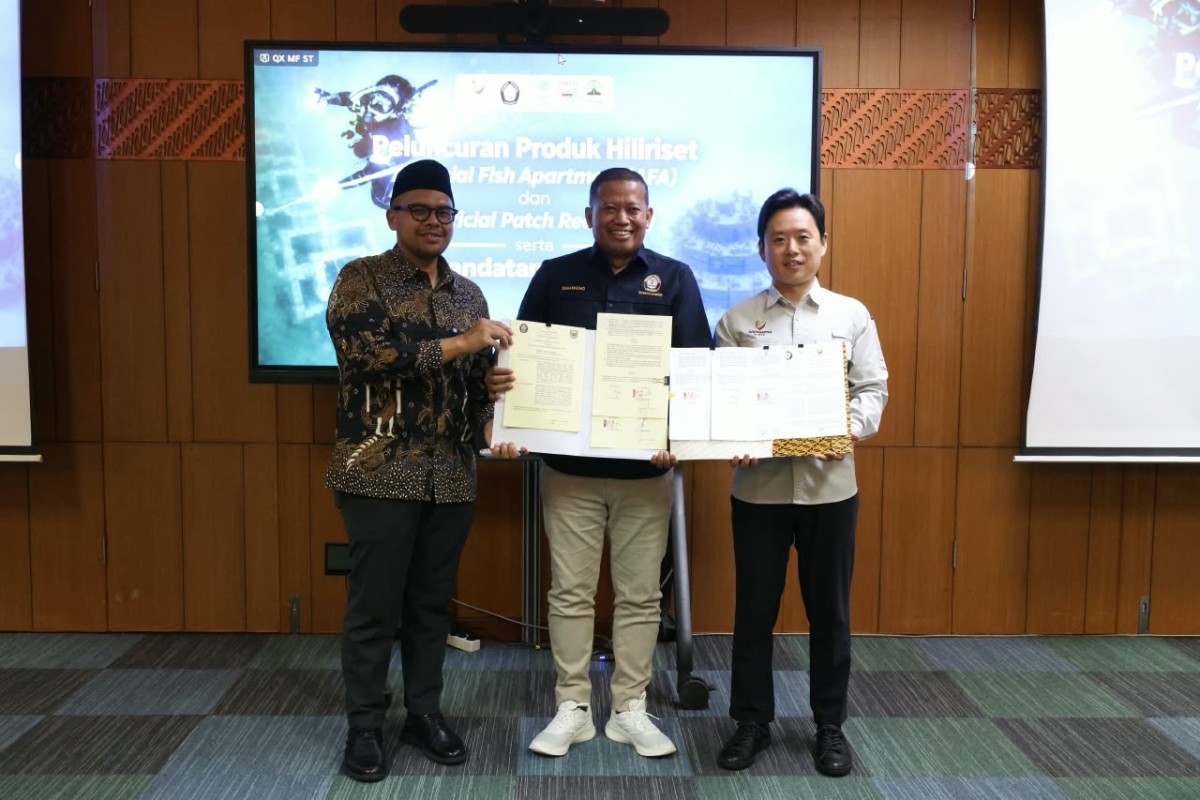
UNDIP and Bhimasena Power Launch AFA and APR Research Downstreaming Products to Support Marine Ecosystem Restoration in Batang
Bhimasena Power, Batang Power Plant — PT Bhimasena Power Indonesia (BPI), the operator of Batang Power Plant, together with Diponegoro University (UNDIP) and the Batang Regency Government, is strengthening collaboration in the development and research downstreaming of Artificial Fish Apartment (AFA) and Artificial Patch Reef (APR) technologies. This initiative aims to translate research findings into practical applications that support marine habitat restoration, biodiversity conservation, and the sustainability of coastal ecosystems in Batang Regency.
The launch of the AFA and APR research downstreaming products, along with the signing of Memoranda of Understanding (MoUs) between Bhimasena Power and Diponegoro University (UNDIP), and between the Batang Regency Government and UNDIP, took place on October 26, 2026, at the Batang Power Plant Administration Building. The event marked a strengthening of cooperation between BPI and UNDIP, as well as between the Batang Regency Government and UNDIP, to promote research-based innovations that can be implemented in the field and deliver tangible benefits to the environment and local communities.
Batang Regent M. Faiz Kurniawan, S.H., M.H., expressed his appreciation for the collaboration between UNDIP, BPI, and all parties supporting the development of AFA and APR. He emphasized that synergy among government, academia, and the business sector is essential to addressing regional development challenges.
The Regent stressed that research findings need to be translated into tangible innovations that can be implemented and deliver direct benefits to the community. In line with the spirit of the 2026 Priority and Strategic Research Downstreaming Program – Industry Initiative, the success of research downstreaming should not be measured solely by technological sophistication, but also by practical application, tangible benefits, and the long-term sustainability of its outcomes for the environment and community welfare.
In his remarks, the Regent also highlighted the importance of maintaining a balance between coastal ecosystem conservation and the sustainability of local livelihoods. Fishermen and coastal communities need to be actively involved in program implementation, maintenance, and monitoring. The program's ecological and economic benefits should also be evaluated using measurable indicators.
The Batang Regent also expressed his commitment to developing the AFA-APR implementation area as an educational tourism destination in Batang Regency.
Rector of Diponegoro University, Prof. Dr. Suharnomo, S.E., M.Si., expressed his appreciation for the collaboration between UNDIP and BPI in advancing research downstreaming and transforming research findings into practical innovations that address real-world needs.
“UNDIP appreciates its collaboration with PT Bhimasena Power Indonesia in the development and research downstreaming of Artificial Fish Apartment (AFA) and Artificial Patch Reef (APR) technologies. This collaboration reflects UNDIP’s commitment to working closely with industry and addressing industrial needs in Batang Regency through research, innovation, and the practical application of knowledge. We hope this partnership will continue to grow and deliver tangible benefits to industry, the environment, and the community,” said the UNDIP Rector.
AFA units are designed to provide and expand fish habitats, while APR units support the restoration of seabed habitats and coral reef growth. The program utilizes Fly Ash and Bottom Ash (FABA) from Batang Power Plant as material for artificial habitats, applying a circular economy approach while ensuring that implementation is guided by scientific studies, responsible management, and regular monitoring.
Chief Operating Officer of PT Bhimasena Power Indonesia, Naofumi Yasuda, stated that the development of AFA and APR forms part of the company's Corporate Social Responsibility (CSR) program and reflects its support for environmental management and coastal ecosystem conservation.
“As a company operating in Batang, we continuously build synergies with all stakeholders. We believe that the best results can be achieved when everyone works together as one team,” said Naofumi Yasuda.
BPI also continues to fulfill its environmental management and monitoring commitments as stipulated in its Environmental Impact Assessment (AMDAL) documents, including the Environmental Management Plan and Environmental Monitoring Plan (RKL-RPL). These efforts cover environmental management, coastal ecosystem protection, and the monitoring of environmental conditions and biodiversity in collaboration with partners with relevant scientific expertise.
Under the collaboration between BPI and UNDIP, four AFA units and eight APR units were installed during the 2020–2025 period. In 2026, the program continued with the installation of an additional 12 AFA units and 10 APR units.
UNDIP's monitoring results in 2025 at one of the APR units in Karang Sebapang identified 19 coral reef fish species, comprising a total of 208 individual fish. These findings provide an initial indication of the role artificial habitats can play in supporting marine life. Continued monitoring remains necessary to evaluate habitat development and the program's ecological impacts based on scientific data.
In addition to supporting AFA and APR development, BPI collaborates with the government and various stakeholders on coastal community empowerment programs. These initiatives include boat engine maintenance and repair training for fishermen, the provision of 11 boat engines to 11 fishermen's groups, health insurance coverage for 149 fishermen, a home renovation program for three fishing families in East Roban, free electricity connections, and mangrove planting along the Batang coastline.
The Batang Regent also emphasized that the collaboration must be followed by concrete programs, clearly defined responsibilities, measurable success indicators, and structured evaluation mechanisms. Scientific monitoring of coral growth, biodiversity, and fish habitat functions must also continue to ensure that program progress can be evaluated using reliable and accountable data.
Through collaboration among government, universities, businesses, and local communities, BPI hopes that the research downstreaming and development of AFA and APR will continue to contribute to coastal ecosystem conservation while supporting environmental sustainability and the well-being of communities in Batang Regency.